
Economy Middle East Summit 2026: Nahyan bin Mubarak Opens Abu Dhabi Forum as UAE Pushes ‘Economy of Tomorrow’
Abu Dhabi summit highlights UAE’s future growth strategy, focused on trade, AI, finance, clean energy, investment and economic diversification.
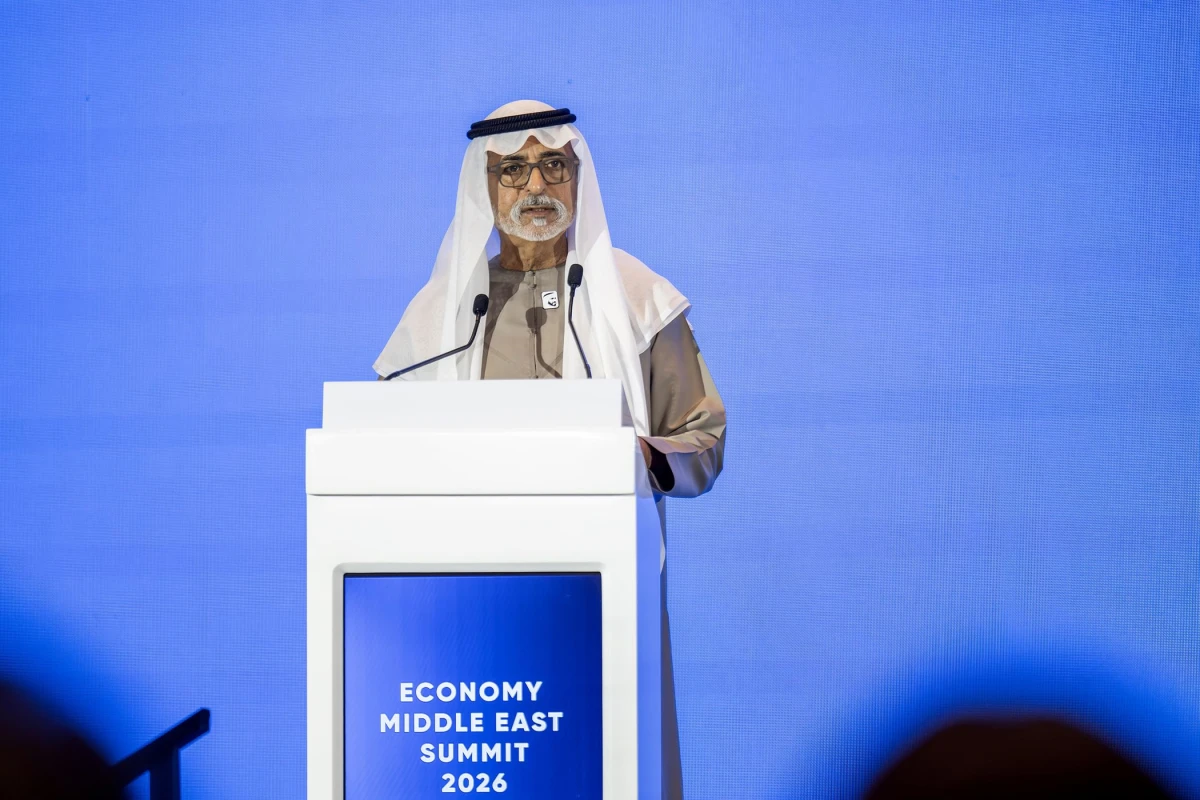
ABU DHABI — The Economy Middle East Summit 2026 opened in Abu Dhabi with a message aimed at investors, policymakers and business leaders: the UAE wants to turn its current economic expansion into a longer growth cycle built on capital markets, technology, trade, clean energy and regional cooperation.
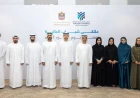
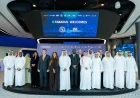
Sheikh Nahyan bin Mubarak Al Nahyan, Minister of Tolerance and Coexistence, inaugurated the summit at Rosewood Abu Dhabi. The event was held in partnership with Abu Dhabi Global Market and brought together more than 1,500 ministers, senior officials, investors, decision-makers and private-sector leaders, according to the Emirates News Agency, WAM.
The summit’s theme, “The Economy of Tomorrow: The UAE Emerges Stronger,” comes as the country continues to report strong headline growth. UAE real GDP grew 6.2% in 2025 to AED 1.9 trillion, while non-oil GDP rose 6.8% to AED 1.5 trillion, according to figures reported by Reuters.
That backdrop gave the summit a sharper edge. This was not a routine business forum. It was a platform for the UAE to show how it plans to protect growth in a more volatile global economy while positioning Abu Dhabi as a hub for capital, artificial intelligence, finance and regional investment.
UAE pitches stability as an economic advantage
In his keynote address, Sheikh Nahyan said the UAE continues to show “resilience, stability, unity” during a challenging period. The phrase captured the core message of the summit: in a region often shaped by geopolitical risk, the UAE is presenting predictability as an economic asset.
He linked that stability to economic openness, sound policy, investment in people, entrepreneurship and regional cooperation. He also pointed to the need for cooperation in artificial intelligence, financial technology, cybersecurity, digital assets and cross-border commerce.
The remarks placed Abu Dhabi at the centre of a wider economic argument. The UAE wants to be seen not only as a beneficiary of regional capital, but also as a builder of the systems that will direct it.
That means financial regulation, digital infrastructure, trade corridors, energy transition projects and private-sector development are no longer separate stories. They are now part of one national growth strategy.
In his keynote address, Sheikh Nahyan said the UAE continues to show “resilience, stability, unity” during a challenging period. The phrase captured the core message of the summit: in a region often shaped by geopolitical risk, the UAE is presenting predictability as an economic asset.
He linked that stability to economic openness, sound policy, investment in people, entrepreneurship and regional cooperation. He also pointed to the need for cooperation in artificial intelligence, financial technology, cybersecurity, digital assets and cross-border commerce.
The remarks placed Abu Dhabi at the centre of a wider economic argument. The UAE wants to be seen not only as a beneficiary of regional capital, but also as a builder of the systems that will direct it.
That means financial regulation, digital infrastructure, trade corridors, energy transition projects and private-sector development are no longer separate stories. They are now part of one national growth strategy.
Why investors are watching Abu Dhabi
Abu Dhabi’s role in the summit matters. The emirate is using its financial institutions, sovereign wealth funds and regulatory platforms to draw global banks, asset managers, family offices and technology companies.
Reuters reported that ADGM posted a 42% year-on-year increase in active companies in the first half of 2025, reaching 2,972 firms by June 30. Assets under management inside the financial hub also rose 42% over the same broad period.
That growth reflects a broader move by international capital toward the Gulf. The region offers large sovereign funds, a rising private-wealth base, low-tax structures and growing demand for alternative investments.
Dubai remains the region’s commercial and tourism hub. Abu Dhabi is positioning itself as a deeper institutional capital centre. Together, they give the UAE a two-city model that few regional competitors can match.
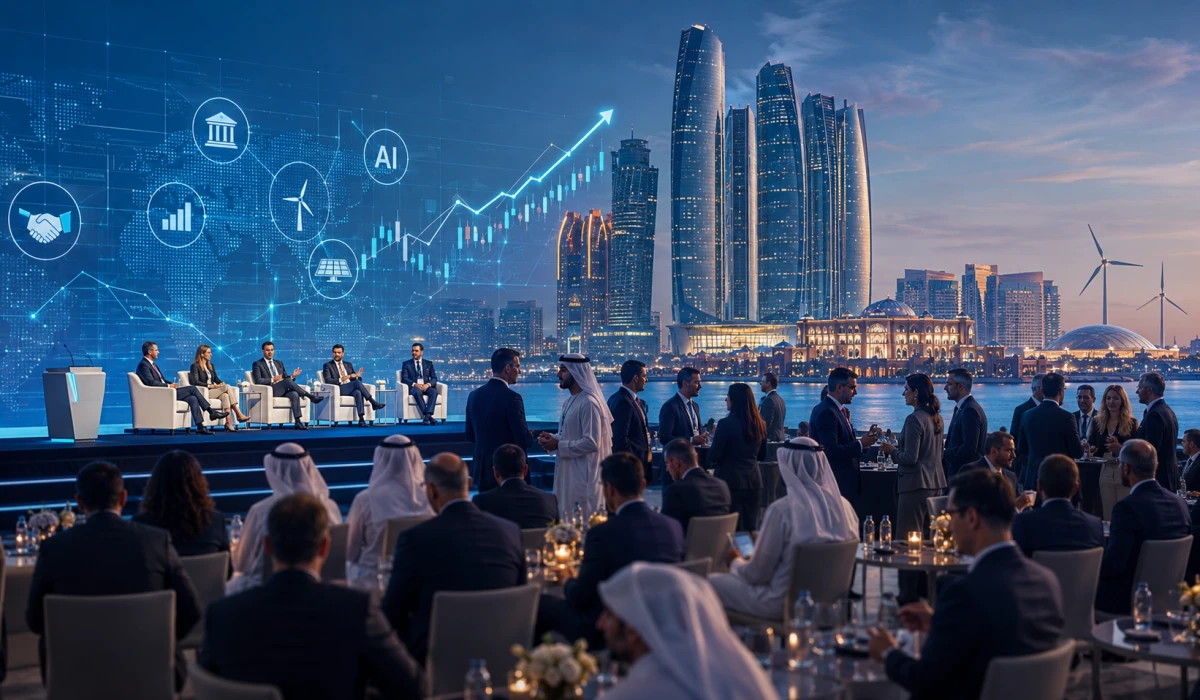
Original research: the data behind the summit
| Indicator | Latest signal | Why it matters |
|---|---|---|
| Summit attendance | 1,500+ participants | Shows high-level government, investor and private-sector interest |
| UAE real GDP | AED 1.9 trillion in 2025 | Confirms the UAE entered 2026 with strong macro momentum |
| Non-oil GDP | AED 1.5 trillion in 2025 | Supports the diversification narrative |
| Non-oil trade | AED 3 trillion in 2024 | Shows trade remains a major growth engine |
| ADGM active companies | 2,972 by June 2025 | Shows Abu Dhabi’s financial hub is scaling |
| UAE PMI | 54.9 in January 2026 | Signals private-sector expansion |
| Dubai PMI | 55.9 in January 2026 | Shows demand strength in the country’s business hub |
| Masdar clean energy capacity | 65 GW globally | Links clean energy to the UAE’s industrial strategy |
| Stargate UAE AI project | First 200 MW expected in 2026 | Shows AI is moving from strategy to infrastructure |
Source note: Figures are compiled from WAM and Reuters reports on the Economy Middle East Summit, UAE GDP, non-oil trade, ADGM, PMI, Masdar and Stargate UAE.
Trade remains the backbone of the UAE model
Trade is one of the clearest pillars of the UAE’s economic strategy. The country’s non-oil goods trade reached a record AED 3 trillion in 2024, up 14.6% from the previous year, according to Reuters.
The same report said the UAE had already reached 75% of its AED 4 trillion non-oil trade target for 2031. That matters because trade is not only a number for the UAE. It is the foundation of its wider investment case.
The country has used ports, airports, free zones and bilateral trade agreements to connect Asia, Africa, Europe and the Middle East. Its Comprehensive Economic Partnership Agreement programme has become a key part of that strategy.
Since 2021, the UAE has negotiated trade and investment deals with countries including India, Indonesia, Israel and Turkey. Exports to CEPA partner countries rose 42.3% year on year in 2024, according to Reuters.
This makes trade a natural fit for the summit’s future-economy theme. The UAE is not trying to grow only through domestic consumption. It is trying to become a platform through which capital, goods, services and technology move across regions.
AI is moving from policy to infrastructure
Artificial intelligence was one of the summit’s central themes. Sheikh Nahyan said the region must guide AI in ways that expand opportunity and preserve ethical responsibility.
That message comes as Abu Dhabi prepares for a major AI infrastructure buildout. The Stargate UAE AI data centre project is expected to begin operations in 2026 with an initial 200 megawatts of capacity.
The wider project is planned as a 10-square-mile AI data centre complex that could eventually reach 5 gigawatts. It involves UAE-based G42 and technology partners including OpenAI, Oracle, Nvidia, Cisco and SoftBank.
This changes the meaning of AI in the UAE economy. AI is no longer only about apps, software or government services. It is becoming a capital-intensive infrastructure sector tied to energy, chips, cloud capacity, cybersecurity and international regulation.
The UAE also joined a U.S.-led AI and semiconductor supply-chain programme in January 2026, according to Reuters. That shows the country wants a place inside the global technology supply chain, not only access to finished products.
Digital assets move closer to the mainstream
The summit also included discussions on digital assets, fintech, banking and finance. That mix is important. It shows that digital finance is moving from a niche topic into the region’s mainstream economic agenda.
The UAE has already built one of the region’s most active regulatory environments for virtual assets. Dubai has its virtual-asset regulator, while ADGM has developed a financial regulatory framework that has helped attract funds, fintech firms and digital-asset companies.
The summit’s partner list included Binance, along with the UAE Cybersecurity Council and ADGM. That combination points to the key challenge in digital finance: innovation must be matched with consumer protection, cybersecurity and regulatory trust.
For investors, the signal is clear. The UAE is not treating digital assets as a separate speculative theme. It is placing them inside a broader finance, technology and regulation agenda.
Clean energy becomes industrial policy
Clean energy was another major topic at the summit. Sheikh Nahyan linked the future economy to clean energy, sustainable finance and climate-smart infrastructure.
That aligns with the UAE’s wider clean-energy push. Masdar, the UAE’s state-owned renewable energy company, reached 65 gigawatts of global clean-energy capacity in 2026 and is targeting 100 gigawatts by 2030.
The energy story also connects with AI. Large data centres require major power supplies, cooling systems and long-term grid planning. If the UAE wants to become a serious AI hub, energy strategy and digital strategy must move together.
That is why clean energy is now more than a climate talking point. It is part of the country’s industrial strategy, investment strategy and technology strategy.
Private sector gets a larger role
One of Sheikh Nahyan’s strongest messages was the need to strengthen the role of the private sector. He said future progress would depend on entrepreneurship, investment, cooperation and the next generation of leaders.
This is a practical point. The UAE can build infrastructure and set policy, but long-term growth will require private companies to create jobs, expand exports, adopt technology and build new services.
The January 2026 PMI data supports that view. The UAE’s non-oil private sector PMI rose to 54.9, while Dubai’s PMI climbed to 55.9, according to
What's Your Reaction?
 Like
0
Like
0
 Dislike
0
Dislike
0
 Love
0
Love
0
 Funny
0
Funny
0
 Wow
0
Wow
0
 Sad
0
Sad
0
 Angry
0
Angry
0
Finance news and analysis writer with two years of experience covering markets, AI, cryptocurrency, fintech, blockchain, investment trends, and digital economy developments for global readers.



Comments (0)