
UAE Salary Payment Rule Drives 151% Jump in Al Ansari Exchange WPS Employer Volumes
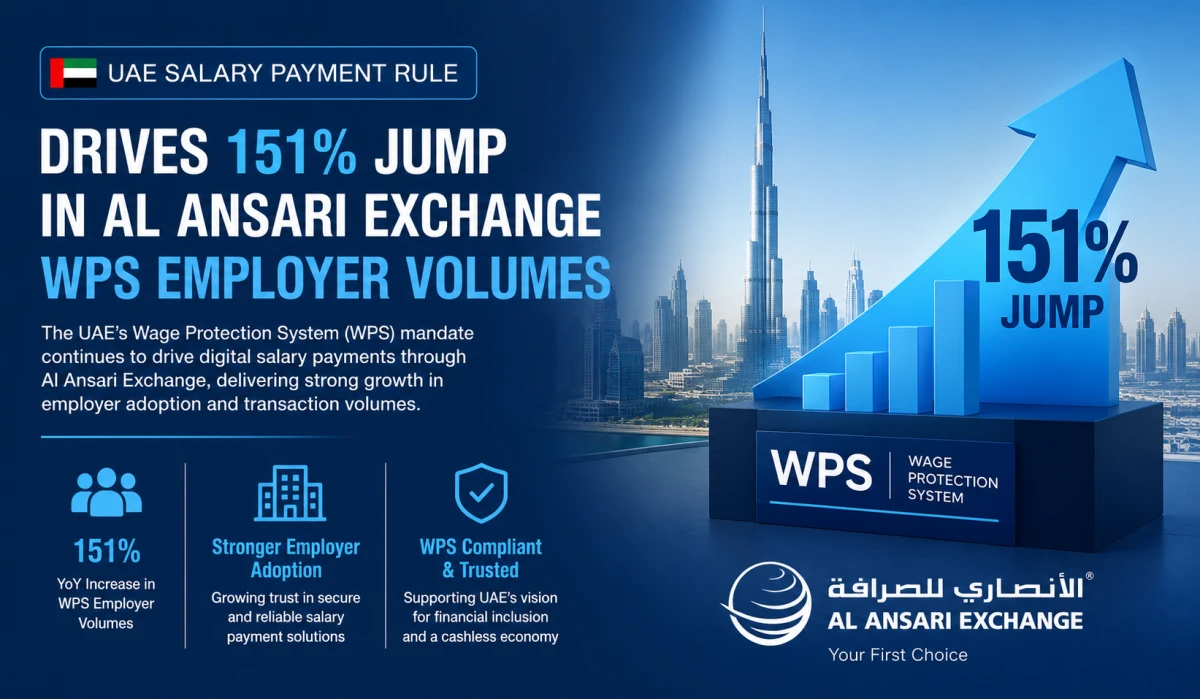
Al Ansari Exchange reported 151% growth in WPS employer volumes after UAE’s new salary payment deadline took effect on June 1.

New WPS deadline pushes UAE companies to process salaries faster and more digitally
Al Ansari Exchange recorded a sharp 151% increase in the number of companies processing salaries through its Wage Protection System platform on June 1, 2026, as private-sector employers across the UAE moved to comply with the country’s updated salary payment rules.
The increase came on the first day of implementation of Ministerial Resolution No. 340 of 2026, which requires private-sector establishments registered with the Ministry of Human Resources and Emiratisation, also known as MoHRE, to pay employee wages through the Wage Protection System by the first day of each month.
The development is more than a business update for one exchange company. It shows how quickly UAE employers are adjusting to a stricter, more unified salary payment timeline. For workers, the change is designed to support more predictable salary payments. For employers, it creates a stronger need for payroll planning, cash-flow discipline, and reliable digital payment systems.
What happened on June 1?
According to the Emirates News Agency WAM report, Al Ansari Exchange said employer activity on its WPS platform more than doubled on June 1, 2026. The company described the surge as a direct response to the new salary payment requirements that came into effect nationwide.
The new rule standardises the salary payment timeline across the private sector. Instead of companies having more flexibility to process monthly wages later in the month, employers are now expected to complete wage payment through approved systems by the first day of each Gregorian month for the previous month’s work.
This matters because the UAE private sector depends heavily on timely payroll processing. Any delay can affect household budgets, rent payments, remittances, loan obligations, and general worker confidence. A clear monthly deadline reduces confusion and helps employees know when they should expect their salary.
Why the Wage Protection System matters
The Wage Protection System, commonly known as WPS, is the UAE’s electronic salary transfer system. It allows employers to pay workers through approved banks, financial institutions, and exchange houses. The system is jointly linked to labour-market supervision and financial infrastructure, allowing authorities to monitor whether wages are paid on time and in line with employment contracts.
MoHRE describes WPS as an “innovative electronic system” that facilitates wage transfers through approved financial channels. The Central Bank of the UAE says the UAEWPS provides a “safe, secure, efficient and robust mechanism” to streamline timely wage payments.
In simple words, WPS is not just a payment method. It is a compliance and protection tool. It creates a digital record of wage payments, supports regulatory monitoring, reduces cash-based salary disputes, and gives both employers and workers a clearer payment trail.
Government data shows the scale of WPS in the UAE
Government data shows that WPS has become one of the most important labour-market systems in the country. MoHRE said in a previous update that the Wage Protection System covers more than 99% of private-sector workers, with total monthly transfers exceeding AED 35 billion.
That figure shows the size of the salary payment ecosystem now moving through digital and regulated channels. It also explains why any change to WPS rules has a major impact on companies, exchange houses, banks, payroll teams, HR departments, and millions of workers.
The Central Bank of the UAE states that UAEWPS was implemented in 2009 to meet the objectives of the then Ministry of Labour, now MoHRE. Since then, the system has been adopted by several authorities and has become a core part of wage governance in the UAE.
Al Ansari Exchange says digital payroll is becoming more important
Ali Al Najjar, Chief Executive Officer of Al Ansari Exchange, said the implementation of the ministerial resolution is an important step in strengthening the UAE labour market. He said the updated framework reinforces “transparency, accountability and employee protection.”
He also noted that employers now need efficient and reliable payroll solutions as they adapt to the new requirements. Al Ansari Exchange said it will continue investing in its WPS infrastructure and digital payroll solutions to help businesses manage salary payments more efficiently.
This is important for small and medium-sized businesses as well as larger companies. Many SMEs may not have large finance teams, so they need easy payroll tools, clear reminders, and fast processing channels to avoid delays.
What employers must understand
The new salary payment framework makes payroll timing a business priority. Employers should not treat WPS as a last-minute monthly task. They need to plan salaries before the deadline, keep enough balance ready, check employee records, and coordinate early with their approved WPS provider.
Companies should also review employment contracts, salary information files, bank details, and employee data before processing wages. Incorrect employee details, missing records, or late approvals can create avoidable delays.
For companies with large workforces, the safest approach is to build a fixed internal payroll calendar. HR and finance teams should prepare salary files before month-end, confirm approvals, and process payments early enough to meet the first-day requirement.
What employees should know
For employees, the updated system strengthens the expectation that salaries should be paid on time. The UAE Government Portal explains that establishments registered with MoHRE must pay wages on the due date through WPS. It also states that if a payment period is not specified in the contract, employees must be paid at least once a month.
Workers should keep their employment contract, salary records, and bank or payroll card information updated. If there is a salary delay, they should first check with the employer’s HR or finance department. If the issue continues, they can contact MoHRE through official service channels.
The rule is especially important for workers who depend on monthly remittances and fixed financial commitments. A predictable salary date helps them plan expenses and reduces uncertainty.
UAE’s wider labour-market direction
The WPS update fits into the UAE’s broader labour-market strategy. In December 2025, MoHRE announced an upgraded WPS in collaboration with the Central Bank of the UAE, Al Etihad Payments, and approved financial institutions. The ministry said the update supports digital transformation, transparency, and competitiveness in the labour market.
MoHRE also said the enhanced system allows employers to manage salary payments more easily through real-time data integration between ministry systems and financial institutions. This helps speed up registration, verification, and salary tracking.
The UAE has been steadily moving toward a more digital and transparent labour system. From work permits and labour contracts to salary protection and dispute reduction, the goal is to create a business environment that is easier for compliant employers and safer for workers.
Why this is an evergreen business story
The 151% increase reported by Al Ansari Exchange is a timely news point, but the bigger story is long-term. Payroll compliance in the UAE is now a permanent business requirement. Companies that invest in better payroll systems, digital salary processing, and early planning will be better placed to avoid disruptions.
The change also creates opportunities for banks, exchange houses, fintech companies, and payroll service providers. As more employers rely on digital salary systems, the demand for fast, secure, and compliant payroll solutions is likely to grow.
For the UAE economy, timely wage payment supports worker stability, reduces labour disputes, and builds confidence in the private sector. It also helps position the country as a regulated and transparent market for investors, employers, and employees.
Public official source quotes
MoHRE: “UAE labour market legislation requires private-sector establishments to pay their workers’ wages on a monthly basis.”
Central Bank of the UAE: UAEWPS provides a “safe, secure, efficient and robust mechanism” for timely wage payments.
MoHRE: “The Wage Protection System covers more than 99% of private-sector workers.”
UAE Government Portal: If no payment period is specified, the employee must be paid “at least once a month.”
Useful external links
For official guidance, readers can check the Ministry of Human Resources and Emiratisation Wages Protection System page: https://www.mohre.gov.ae/en/guidance-and-awareness-portal-new/wages-protection-system
For UAEWPS details from the Central Bank of the UAE: https://www.centralbank.ae/en/our-operations/payments-and-settlements/uae-wages-protection-system-uaewps/
For salary payment information on the UAE Government Portal: https://u.ae/en/information-and-services/jobs/employment-in-the-private-sector/payment-of-wages
Conclusion
Al Ansari Exchange’s 151% jump in WPS employer volumes shows how quickly UAE businesses responded to the new salary payment deadline. The updated rule strengthens the country’s wage protection framework and gives private-sector employees a clearer expectation of when salaries should be paid.
For employers, the message is simple: payroll must be planned earlier, processed digitally, and handled through approved WPS channels. For workers, the reform supports timely salary payment and stronger protection of wage rights.
As the UAE continues to modernise labour-market systems, WPS is becoming more than a compliance tool. It is now a central part of the country’s digital economy, worker protection framework, and business confidence strategy.
What's Your Reaction?
 Like
0
Like
0
 Dislike
0
Dislike
0
 Love
0
Love
0
 Funny
0
Funny
0
 Wow
0
Wow
0
 Sad
0
Sad
0
 Angry
0
Angry
0

Finance journalist and commentator covering regional business, banking, investment, and economic trends. Focused on delivering accurate reporting, insightful analysis, and informed perspectives.














Comments (0)