
GCC Stock Trading Hits $618 Billion—Why Dubai Stands Out
GCC exchanges recorded $618 billion in share trading during 2025. Despite falling regional market value, Dubai emerged as one of the strongest performers.
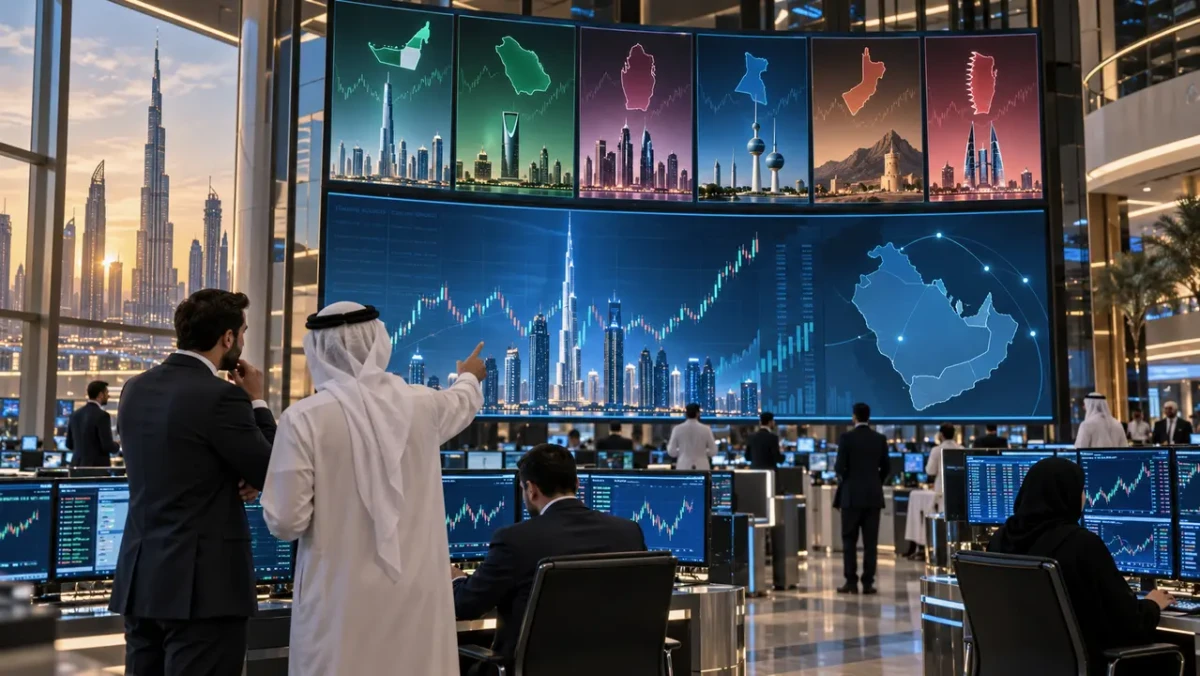
GCC exchanges handled 401.7 billion shares in 2025, but falling regional market capitalisation shows that higher trading activity did not translate into broad gains for investors.
Stock trading across Gulf Cooperation Council markets reached approximately $618 billion in 2025 as investors exchanged a record 401.7 billion shares, according to new data released by the GCC Statistical Centre.
The number of shares traded increased 19.5% from the previous year, pointing to higher market participation and liquidity across the region. Yet the GCC-Stat composite market index fell 3.8%, while total market capitalisation declined 6.2% to about $3.9 trillion.
The contrasting figures reveal a divided year for Gulf equities. Investors traded more shares, but falling valuations among some of the region’s largest companies reduced the combined market value of GCC exchanges.
Dubai was a notable exception. Independent research from Kamco Invest shows that the Dubai Financial Market General Index gained 17.2% during 2025, making it one of the region’s stronger performers. Kuwait and Oman also recorded double-digit advances, while Saudi Arabia’s much larger market declined.
For UAE investors, the data show why regional headline figures can conceal significant differences between exchanges. The direction of Saudi Arabia’s market can heavily influence GCC totals because of its size, even when Dubai, Abu Dhabi and several smaller markets are rising.
Higher volume, lower valuation
Trading volume and market capitalisation measure different aspects of an equity market.
The 401.7 billion shares traded represent the number of shares bought and sold during the year. The 19.5% increase can indicate more active investors, stronger retail participation or heavier turnover in lower-priced stocks.
Market capitalisation, meanwhile, measures the value of listed companies based on their share prices. It can decline even as trading activity rises if major companies lose value.
GCC-Stat said the combined capitalisation of Gulf exchanges fell from approximately $4.2 trillion at the end of 2024 to $3.9 trillion in 2025. The $300 billion reduction does not represent money physically withdrawn from exchanges. It reflects the change in the market value assigned to listed companies.
Saudi Arabia was the main source of regional weakness. Kamco Invest calculated that the Tadawul All Share Index fell 12.8% in 2025, its largest annual decline in a decade. Saudi Aramco shares declined 15%, adding significant pressure because the energy company represents a substantial share of regional market capitalisation.
Lower oil prices, tariff uncertainty and geopolitical concerns affected investor sentiment during the year. Brent crude fell 18.5% in 2025, according to Kamco, weakening the outlook for energy companies and government revenue across oil-producing economies.
Dubai delivers one of the GCC’s strongest returns
Dubai’s market moved in the opposite direction.
The DFM General Index gained 17.2% in 2025, supported by listed companies in banking, real estate, transport and utilities. Strong population growth, tourism, property activity and the expansion of Dubai’s non-oil economy helped sustain investor demand.
The performance followed gains in earlier years, during which government-related companies entered the public market and expanded the range of sectors available to investors.
Dubai’s listing programme has included businesses linked to electricity and water, road tolls, district cooling, parking and other infrastructure. These companies have given investors access to revenue streams connected to the emirate’s population and economic growth.
Their presence has also reduced, though not eliminated, the market’s historical concentration in banks and property developers.
Abu Dhabi recorded a more moderate gain. Kamco’s analysis placed the FTSE ADX General Index’s 2025 increase at 6.1%. Large energy and investment companies continued to dominate the exchange, while banking and property stocks provided additional support.
The difference between the two UAE markets is important. Dubai’s index has greater exposure to tourism, property and consumer-linked infrastructure, while Abu Dhabi includes several companies connected to oil, gas and state-backed investment groups.
Together, the exchanges offer investors a wider range of UAE economic exposure than either market provides individually.
Kuwait and Oman lead regional gains
Oman was the GCC’s strongest-performing equity market in 2025, with its principal index rising 28.2%, according to Kamco. Kuwait followed with a 21% gain.
Kuwait’s rally was broad enough to lift banking, telecommunications, real estate and energy shares. Trading volume on Boursa Kuwait rose 71.3% to 117.2 billion shares, while traded value increased 79.1% to 26.5 billion Kuwaiti dinars.
Qatar and Bahrain recorded smaller positive returns, while Saudi Arabia was the only principal GCC market covered by Kamco to finish the year with a decline.
These differences explain how the GCC composite index could fall despite gains in five of the six member-state markets. Saudi Arabia’s much larger weighting meant its decline outweighed advances elsewhere.
Investors assessing “GCC equities” should therefore examine the composition of the benchmark being used. A market-capitalisation-weighted regional index will naturally be heavily influenced by Saudi companies and the energy sector.
Market access continues to expand
The GCC had 779 listed companies at the end of 2025, according to GCC-Stat.
Shares in 756 of those companies were available to citizens of GCC member states, representing 97% of all listed businesses. Eligibility reached 100% in Bahrain, Kuwait, Oman and Qatar.
Cross-border access for GCC citizens is an important part of the region’s plan to develop a more integrated capital market. Regulators are also working on dual listings, electronic connections between exchanges and unified investor identification systems.
Investment-fund passporting rules came into force as the first common GCC regulatory framework covering a financial product. Passporting is intended to make it easier for an authorised fund in one GCC state to be marketed in another, subject to the agreed framework and local implementation requirements.
If used widely, the system could help UAE fund managers reach investors across the Gulf without creating an entirely separate product in every jurisdiction. Dubai and Abu Dhabi could benefit because both have established asset-management, fund-administration and professional-services sectors.
However, formal eligibility does not guarantee active cross-border investment. Differences in settlement, disclosure, taxation, foreign-ownership rules and investor familiarity can still discourage participation.
Regulatory reforms target liquidity and trust
GCC markets introduced or developed rules covering corporate governance, public offerings, investment funds, market making and trading conduct during 2025.
Market makers can improve liquidity by continuously offering to buy and sell securities, reducing the gap between bid and offer prices. This is particularly relevant for smaller companies that may otherwise trade infrequently.
Regulators also expanded sustainability-reporting requirements and rules governing the electronic issuance of securities. Work continued on bond and sukuk trading, dual listings and connections between regional exchanges.
For Dubai, deeper GCC integration could increase the potential investor pool for DFM-listed companies. It may also encourage more private businesses to consider public listings if they can access investors throughout the region rather than relying mainly on domestic demand.
The region’s 779 listed companies remain a relatively small number compared with the scale of the GCC economy and its privately held corporate sector. Many large family-owned businesses have yet to enter public markets.
Increasing private-sector listings would diversify exchanges beyond governments, banks, energy companies and state-related infrastructure businesses.
Stronger foundations, but new risks in 2026
The 2025 data describe markets before the escalation in regional conflict and the renewed disruption of energy and shipping routes during 2026.
Recent volatility has affected Gulf equities unevenly. Higher oil prices may support some energy producers, but conflict also raises insurance, logistics and financing costs while discouraging risk-taking.
Dubai is particularly sensitive to international trade, tourism, aviation and property sentiment. Its strong 2025 performance provides a useful foundation, but it does not guarantee similar returns when geopolitical conditions change.
Investors should watch whether trading activity remains strong, whether regional IPOs return after periods of volatility and whether cross-border reforms produce measurable investment flows.
The central message from the GCC-Stat figures is not simply that $618 billion of shares changed hands. Gulf exchanges are becoming more active and accessible, but their performance remains highly uneven.
Dubai’s 2025 gains show the value of economic diversification and a broader listed-company base. The next stage will depend on whether the GCC can convert regulatory integration and higher trading volume into deeper liquidity, more private-company listings and durable investor confidence.
Fact-check and sources
Frequently Asked Questions
What's Your Reaction?
 Like
0
Like
0
 Dislike
0
Dislike
0
 Love
0
Love
0
 Funny
0
Funny
0
 Wow
0
Wow
0
 Sad
0
Sad
0
 Angry
0
Angry
0

Journalist and commentator covering Dubai and the UAE, with a focus on local development, AI, finance, investment, cryptocurrency, technology, and major events. Focused on accurate reporting, insightful analysis, and informed perspectives on the trends shaping Dubai and the wider UAE.








Comments (0)